 |
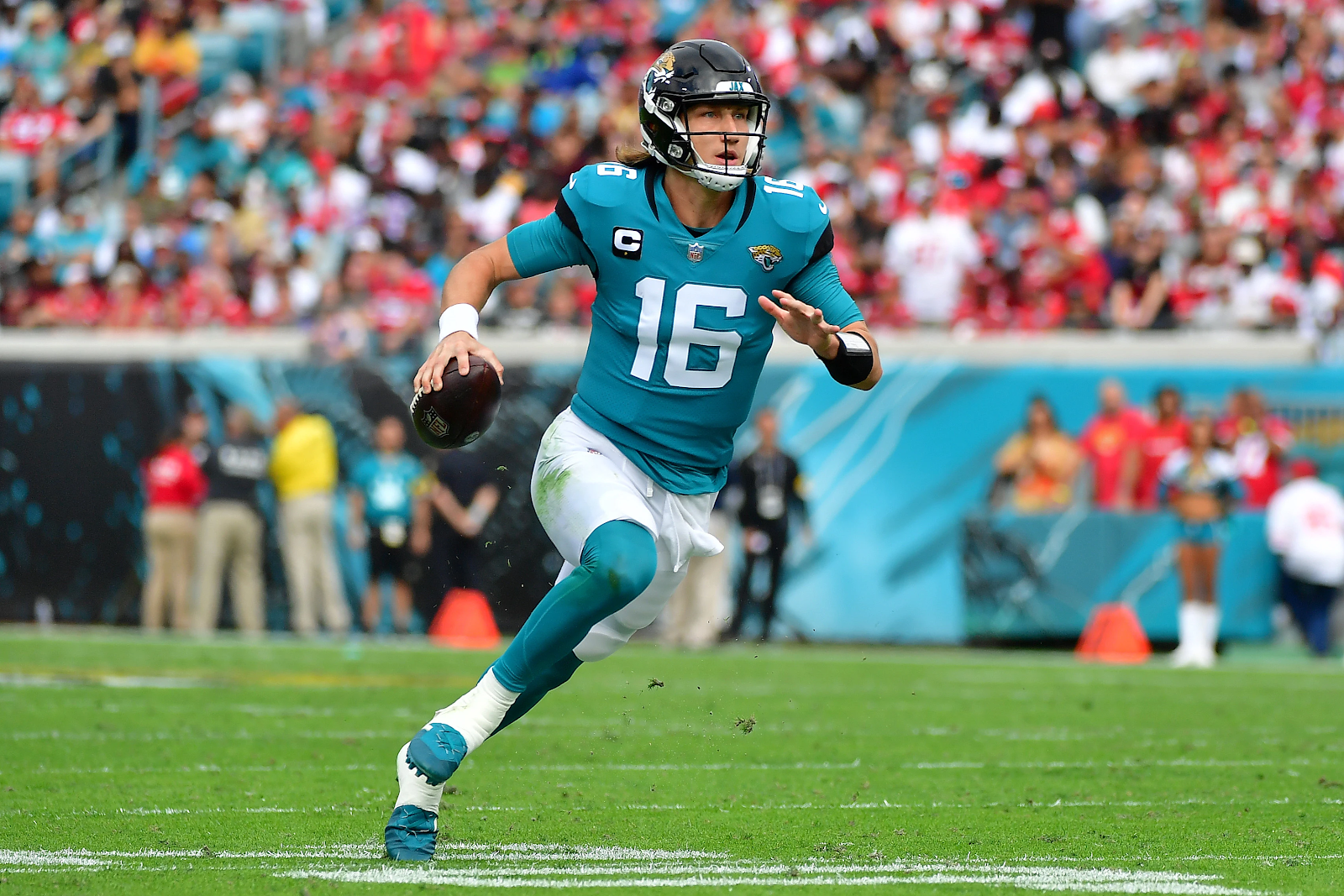
| Trevor Lawrance on the run, via the New York Post |
Well, that was one the most remarkable seasons that I can remember in all of my years of watching sports. It's taken a few days to process everything that happened this year after that loss to the Chiefs, but we sure had a wild ride out here in Duval County this year.
These Jacksonville Jaguars were a revelation, and the future of this franchise looks very bright. The Jags were in just about every game this season, only suffering a single blow-out to the Detroit Lions, and they illustrated a unified, cohesive, and skilled approach to the game in winning both the AFC South Division and a playoff game over the L.A. Chargers.
Doug Pederson's influences on this young team were immediate and profound. After the clown-show that was Urban Meyer's brief tenure here in Jacksonville (he literally didn't know our players' names and couldn't talk about their status in pre or post-game interviews, and ignorance was the least of his transgressions...), Pederson (we all just call him 'Doug') proved to be motivational, even-keeled, and innovative. I've never seen a coach scheme guys open the way that Doug does. He calls the offensive plays, and our wideouts, backs, and tight ends are consistently open. He coaches with aggressive instincts. I've never seen a team go for it this much on fourth down, but he never becomes a prisoner of the moment. He assesses things, crunches the numbers, and he seems bound by his convictions. He coached one of the most masterful games I've ever seen in my life in that comeback win over the Chargers in the first week of the playoffs and is one of the finest coaches in the league.
Doug is the AFC Coach of the Year, and the award is well-deserved.
The defense showed steady improvement over the course of the year, playing its best football throughout that amazing winning streak we finished the year on. There are some huge financial decisions to make in the offseason, but the future looks bright. Travan Walker flashed (he had a pick and a sack in his first game) some dominating skills and Devin Lloyd won the AFC defensive rookie of the month award to begin his career with JAX. He hit a lull midway through the year, often getting burned in coverage, but finished the season on a much better note. I expect that he will have a really positive offseason and come back ready to start and dominate in 2023/24. He is the answer to guys like Kelce once he gets a better feel for the NFL game, because his athleticism is off the charts.
Foye Aluokun was last year's best free-agent signing, and the future looks bright for the defense with him as the captain and the defensive maestro. A Yale graduate, he does a good job of setting the defense and putting his teammates in position to make plays. He's a tackling machine that should have been awarded Pro-bowl status, at the very least. I hope defensive coordinator continues to find ways to get Foye into blitzes, because he can go get that quarterback down on the ground just as well as he flies to the football.
Tyson Campbell, Rayshawn Jenkins (our second-half defensive MVP), Andre Cisco, and Darious Williams form the core of a fine secondary. Jenkins is an unrestricted free agent and will garner much interest on the open market. I don't know that he'll be back in Jacksonville next year, but I certainly hope they can find a way to make it happen.
The Jaguars offense was led, of course, by Trevor Lawrence. His maturation in his second season was astounding, and it's pretty clear we've never had a quarterback of this skill level (and we all love you dearly, Mark, Blake, and David!) here in Jacksonville. He threw for more than a thousand yards, distributing the ball in a remarkable balanced fashion to a wideout corps that led the NFL with forty-one drops. Just think of how many more yards he might have if that number is cut in half? That's twenty more completions right there...he is mobile, instinctive (he improvised that two-point conversion in the win over the Chargers in the playoffs), and has a cannon for an arm. He makes throws that only a few others in the league can make, and we're talking the likes of Allen and Mahomes. Lawrence is a superstar, and he just gets it. He's embraced Jacksonville, and I truly think this team will be competitive (and maybe dominant, if Trent Baalke can surround him with some transcendent young talent via the NFL draft) as long as he is at the helm of this offense. We are blessed to have him, for many reasons beyond his prowess on the field...
Travis Etienne went over a 1,000 yards rushing for the first time in his career. He is a homerun back with surprising grit between the tackles. He also catches that little flair screen and gets north/south quickly. He needs to work on ball security and pass-blocking, but I sense that he will come into his own as one of the top eight backs in the NFL as soon as next season. His future is very bright, and I hope we can get JaMycal Hasty extended to continue in his complementary role this offseason. I've read some pundits calling for another back for the room, but I think Snoop Conner can continue to grow into that role as a thumper and we are good at that position for the near future.
Let me say this without qualification: I love Christian Kirk. He is a pro's pro, an engaging, smart young man, and a fast, talented wideout. He had two glaring drops that I can recall off the top of my head (both against KC, and one in each game), but he also made at least ten remarkably difficult, hotly contested catches. He gets credit for those of course, and none was bigger than that catch at the boundary against L.A. in the playoffs. When Calvin Ridley lines up on the opposite side, he'll have even greater opportunity and I expect that he will eclipse this year's fine season next year with some help taking the pressure off of him.
Zay Jones was awesome as well. Despite a bad game at midseason (he was clearly playing injured), he made contested catches, ran away from defenses, and converted loads of third downs. Ridley, Zay, Christian, and Ags (Jamal Agnew) comprise a formidable wideout corps. Marvin Jones, Jr. possesses some of the best body control I've ever seen and has been a steadying, consistent presence on the team. I'm not sure if he will come back on a cheaper contract next year, but I hope we can find a way to keep him and maybe draft a developmental prospect in the second or third rounds of this year's draft.
Evan Engram is a force, and his play improved on a weekly basis. A true stretch tight end, he is fast, tough, and plays with a chip on his shoulder. Doug schemed him open a lot, and he had a few huge games late in the year. He wants to be here, but he will be expensive. That said, we need to sign him up. He's young, hungry, and has a great rapport with Trevor.
The previously mentioned Agnew was also consistently amazing. He is a weapon returning punts and kicks, and he made a ton of plays on offense. This is his second excellent year in Duval, and he is deserving of a new contract.
Roy Robertson-Harris, Agnew, Engram, Jenkins, Adam Gotsis, Arden Key, Jawaan Taylor, Andrew Wingard, Dawaune Smoot, and kicker Riley Patterson are the most critically important free agents I'd like to see back. Smoot tore his Achilles tendon and I really feel for him, because he has been a consistently solid performer throughout his tenure as a Jaguar. I hope we can bring all of them back, but that is probably asking quite a lot. We need to take care of another batch of rookies, and Doug and Baalke will be working together to scour free agency in the offseason.
That said, the core of this team is talented and impressive. I see more AFC South titles in the near future (the other three teams are all rebuilding, each has QB issues...), and I think Trevor has every tool necessary to mix it up competitively with the likes of Mahomes, Allen, Burrow, and Herbert over the next half-decade.
It was an exhilarating year that culminated with a seven-game win streak, another banner for TIAA Field, and a couple of worthy off-season honors from the NFL. This team will be on prime time next year more frequently, and they will be heavy favorites to repeat as divisional champions.
In short, the future is bright and the foundation has been set. We look young, skilled, and hungry, and in the space of one short season this team has proven its resiliency in a way that none of us--even the most die-hard among us--ever saw coming.
It was always the Jaguars, my friends, and the positivity surrounding this team is well-deserved and refreshing after a few truly dreadful years of football.
Say it with me: DUUUUUUUUUUUUVAL!
 |
| The Powell Family Attends the Jags' Win over Tennessee |


